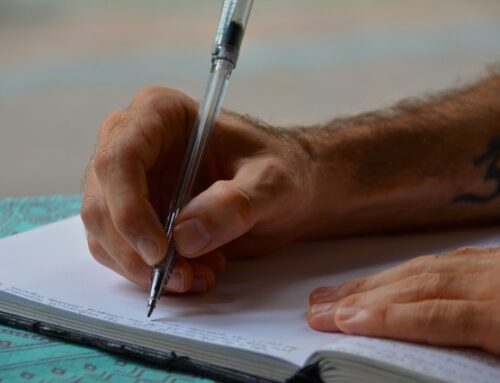

How you can turn your world upside down with just pen and paper.
“All I need is a sheet of paper and something to write with,
and then I can turn the world upside down.”
― Friedrich Nietzsche
Those are some pretty powerful words coming from Nietzsche.
Ok, I know that Nietzsche went crazy in the last decade or so of his life. But there’s no denying that he was a brilliant thinker whose ideas influenced many people. And there’s no denying the truth behind these words in his quote.
He was referring to the physical act of writing — holding a writing implement in one’s hand, putting that on a piece of paper, and moving the implement to form words.
Why did Nietzsche believe that writing was so powerful? Most of us have also heard the saying, “the pen is mightier than the sword”. How could writing be so powerful? What are we missing? And if it’s so powerful as Nietzsche claimed, how come not more people are actually writing stuff by hand?
These days, almost everyone takes writing for granted. A colleague of mine said to me the other day that he couldn’t recall the last time that he wrote something by hand, using a pen and paper.
I can’t say that I’m surprised by what he said. It is true. Since, oh I don’t know, 30 years ago, when computers shrank and word processors became more sophisticated, people started writing less by hand. And when smartphones came into the picture, that practically assured that writing things the old fashioned way, by hand, with pen and paper, would be relegated to the back row of common human activities.
I posit that not only is writing powerful, that not only can it, as Nietzsche wrote, “turn the world upside down”, that not only is it mightier than the sword, but that it is perhaps the most potent and enduring technology ever invented by humankind.
I write these words in praise of writing, of the true power of the technology of writing.

The dictionary definition of the word ‘technology’ is ‘the practical application of knowledge especially in a particular area’, or ‘a capability given by the practical application of knowledge’.
By this definition, writing is technology. Denise Schmandt-Besserat, professor emerita of Art and Middle Studies at the University of Texas at Austin, captured the true nature and essence of writing as technology when she wrote: “Writing is humankind’s principal technology for collecting, manipulating, storing, retrieving, communicating and disseminating information.”
Writing is technology and when we write, we are using possibly one of the earliest, and certainly one of the most important, technologies ever invented. And just as with any technology, writing involves many processes, innumerable techniques. Writing is both a technology and a technique.
Writing is ancient.
The Sumerians invented writing as a way of recording what they spoke. The ancient Egyptians called writing the ‘language of the gods’. The Arabs of old used writing as a tool to elegantly convey ideas. The Roman emperors used writing to proclaim their victories and preserve them forever. At Iona, a remote island off the coast of Scotland, in the 6th century, monks wrote to proclaim and spread Christianity and keep the fire of their faith burning. Today, through the exact same fusion of mind, thoughts, ideas, hand, pen and paper that these ancient peoples employed, we write to convey our joys, triumphs, fears, sadness, grief, despair, hope, faith and gratitude.
Writing is the simplest, most durable and enduring information recording system ever invented.
When something is written on a durable medium, whether rock, marble, papyrus, leather or vellum, it endures indefinitely. To this day, we have samples of writing that come from the dawn of human civilization. Unlike information stored in a hard drive, something that is written down on a physical medium doesn’t crash, get erased or accidentally deleted. It doesn’t need any equipment or other technology to access and read. You simply open the medium it’s written on and read.
Writing is powerful.
It can communicate a message or an idea that was written thousands of years ago, exactly as it was intended to be understood by the writer. While writing was created principally to be the carrier, the recorder, of spoken language, it is infinitely more powerful than the latter. The ability to speak a language dies with the person; what the person wrote, however, endures past death. Writing can solve your most perplexing problems. There are writing techniques that can show you how to turn your brain into the most fantastic problem-solving machine; writing is the mechanism that directs that machine.
Writing clarifies.
The human mind is the most powerful machine in all of creation: properly directed, it can solve any problem. But if left undirected, it also has the destructive capacity to run like an unhinged freight train. Experts estimate that the average human brain thinks 50,000 thoughts in a day, with some experts even saying that number could be as high as 80,000. That’s a lot of thoughts — about 3,000 thoughts per hour, 50 thoughts per minute, and 1 thought per second. And the majority of those thoughts — up to 70% — are negative. Writing is a potent tool to rein in your mind and direct your thoughts only toward desirable outcomes.
Writing is magical.
It transcends time and space. It connects humans in the deepest of ways that no other technology invented can do. Provided we have the ability or the means to understand it, we can read something that was written in a dead language in eons past, and immediately understand what the writer wished to convey at the moment of writing. And with the addition of thought, imagination and emotion, we can also feel exactly what the writer felt at the time of writing.
Describe in vivid detail what you would like to happen a month or a year from now, and forget about what you wrote. Then a month or a year on, read back what you wrote and you might surprised by the eerie feeling that what you described in the past has come to pass in the future.
Writing is the most wonderful time machine ever invented.
It can take you back to your past and your future. It can record the minutest details of an experience. Write something, read it back many years later and find yourself transported back to the moment described in your words.
Through writing, you can create your future. You can describe in vivid detail what you would like to happen a month or a year from now, and forget about what you wrote. Then a month or a year on, you read back what you wrote and you are surprised by the eerie feeling that what you described in the past has come to pass in the future.
This leads me to the last, and most amazing, virtue of writing.
Writing is creative.
And I don’t mean that we can creatively communicate through our writing. I don’t mean creating stories either. Writing creates. I believe Nietzsche was alluding to this attribute of writing when he said, “all I need is a sheet of paper and something to write with, and then I can turn the world upside down.”
Writing can literally create reality — we can shape reality through writing, use it to weave the very fabric of creation — time and space — and to bring into existence circumstances, experiences and conditions that we desire. In short, through writing, we can transform our world and what we perceive as reality.

Writing, therefore, is the cheapest life-altering and life-shaping technology ever created because all you need to start is a pen, a notebook and an optional pocket notebook. You could even use plain sheets of white paper. Ultimately, it doesn’t matter what medium you use; what is important is that you write. So, from here on out, always keep a pen and paper handy wherever you are.
Writing can literally create reality — we can shape reality through writing, use it to weave the very fabric of creation — time and space — and to bring into existence circumstances, experiences and conditions that we desire.
You may not know this yet, but writing really can help you achieve audacious goals, solve any problem, and radically re-engineer your life. And if you’ve already heard that writing can do all these amazing things, but for some reason you haven’t yet brought pen to paper to unleash the true power of writing, then I hope to encourage you to do just that. All the amazing things that writing can bring you lie waiting. The only thing that you have to do is start writing.
Let’s write.
******
To access the techniques of WriteTech and other resources for free, go to writetech.co/#free-resources
Do you have a story to share of how writing has helped you or a friend achieve an ambitious goal or solve a difficult problem? If you’d like to share your story with others to inspire them, send it to Jonathan@writetech.co